An interconnected ecosystem

From farming and honey to resource recovery and training: proposed activities designed to work together on one site.

Discuss the project
Planned farm operations

How do we plan to manage 1,000 hectares from one hub?

The plan places an AI Hub inside Abu Dhabi Green Regenerative Farm to coordinate a 1,000-hectare Grouped Project. Participating farms connect through shared sensor, drone and robotics data, with local controllers supporting safe operation during connectivity interruptions, defined permissions and specialist oversight.

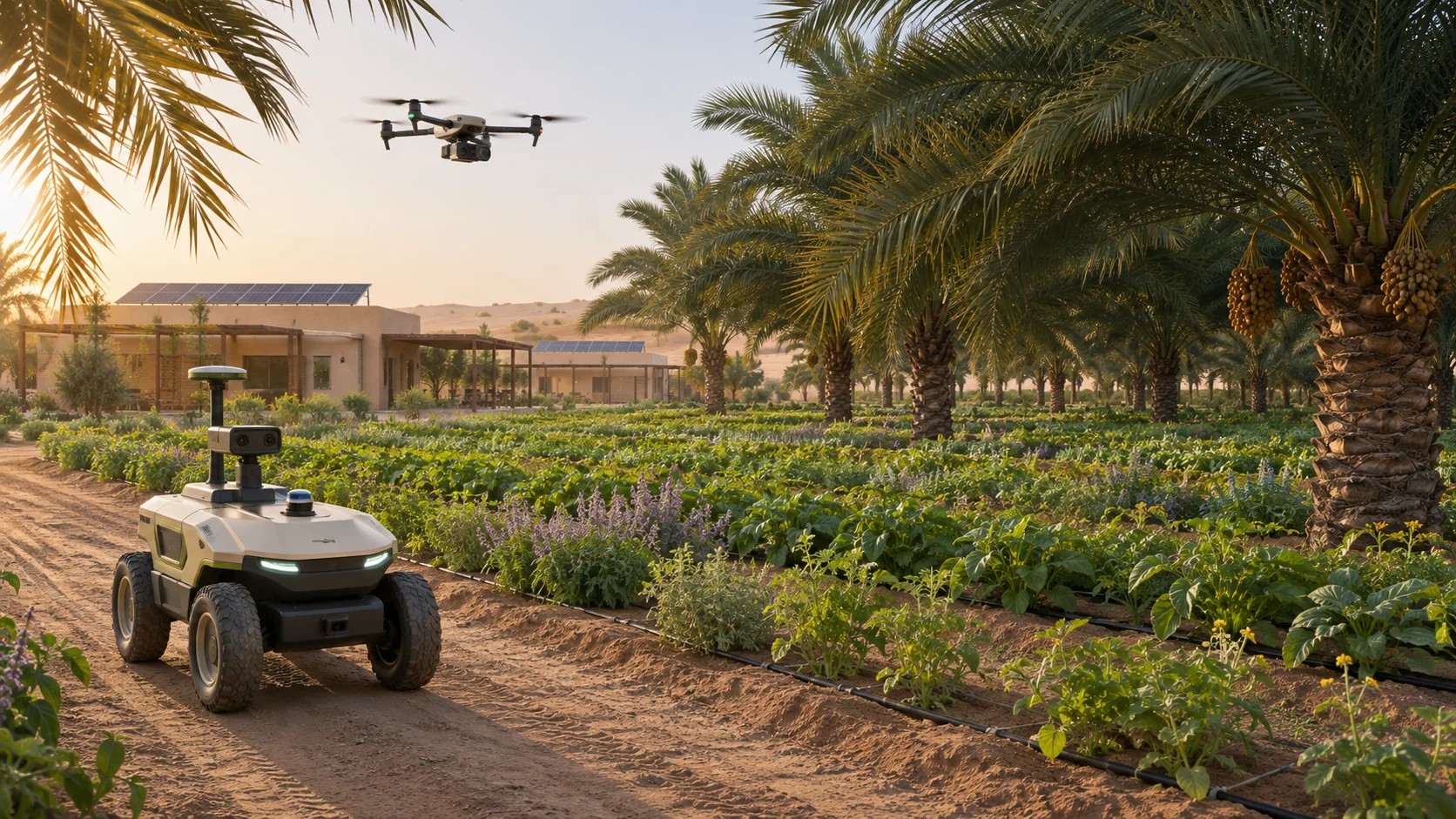
Concept of a monitoring drone and electric agricultural rover among palms and crops
Illustration of proposed intelligent operations, not a record of installed equipment.
01

Drones: coordinated aerial and spectral surveys

A coordinated drone fleet is being assessed for aerial and spectral field surveys, crop-health monitoring and stress mapping, guiding sampling and biological input application where equipment and rules permit. Flight frequency depends on need, weather and permissions. Imagery supports carbon monitoring but does not establish soil-carbon stock changes on its own.

02

Robotics: precise field tasks

Autonomous electric equipment is planned for monitoring, transport and no-till tasks suited to soil, crops and available machinery, with routing, charging and maintenance designed to limit compaction. In the honey facility, robotic sorting and packing target minimal direct product contact (Zero-Touch), with human responsibility for quality and safety.

03

AI and the Digital Twin

The concept connects IoT soil, climate, water and energy data to a Digital Twin of fields and facilities. Updated readings support precision-irrigation scenarios, early fault alerts and resource and task allocation. Sensors and models are regularly calibrated, and consequential decisions remain reviewable with manual intervention and safe stopping.

Automation supports sustainability when its impact is measured

Water, energy and input savings are compared with equipment operation and maintenance costs. AI estimates and drone images remain supporting data alongside sampling, laboratory analysis and independent carbon verification.

Watch & explore · AI & measurement

AI and regenerative farm governance

How do sensors, drones, remote sensing and intelligent analysis connect with measurement and verification records? Explore technology’s role in farm governance and carbon evidence.

3:51Global Experts channel
Explore the company channel
Watch on YouTubePlayer loads on click

Educational content from the company channel; not evidence of completed farm works or awarded certification.

An agricultural & knowledge circular economy

Resources circulate. Value is renewed.

The project is based on a circular economy that connects production with the recovery of useful outputs. The system includes a recycling station designed to deliver green circular-economy objectives through suitable residue sorting, composting and resource recovery. Material, water and energy systems are designed to reduce losses and support product quality, soil health and efficient operations.

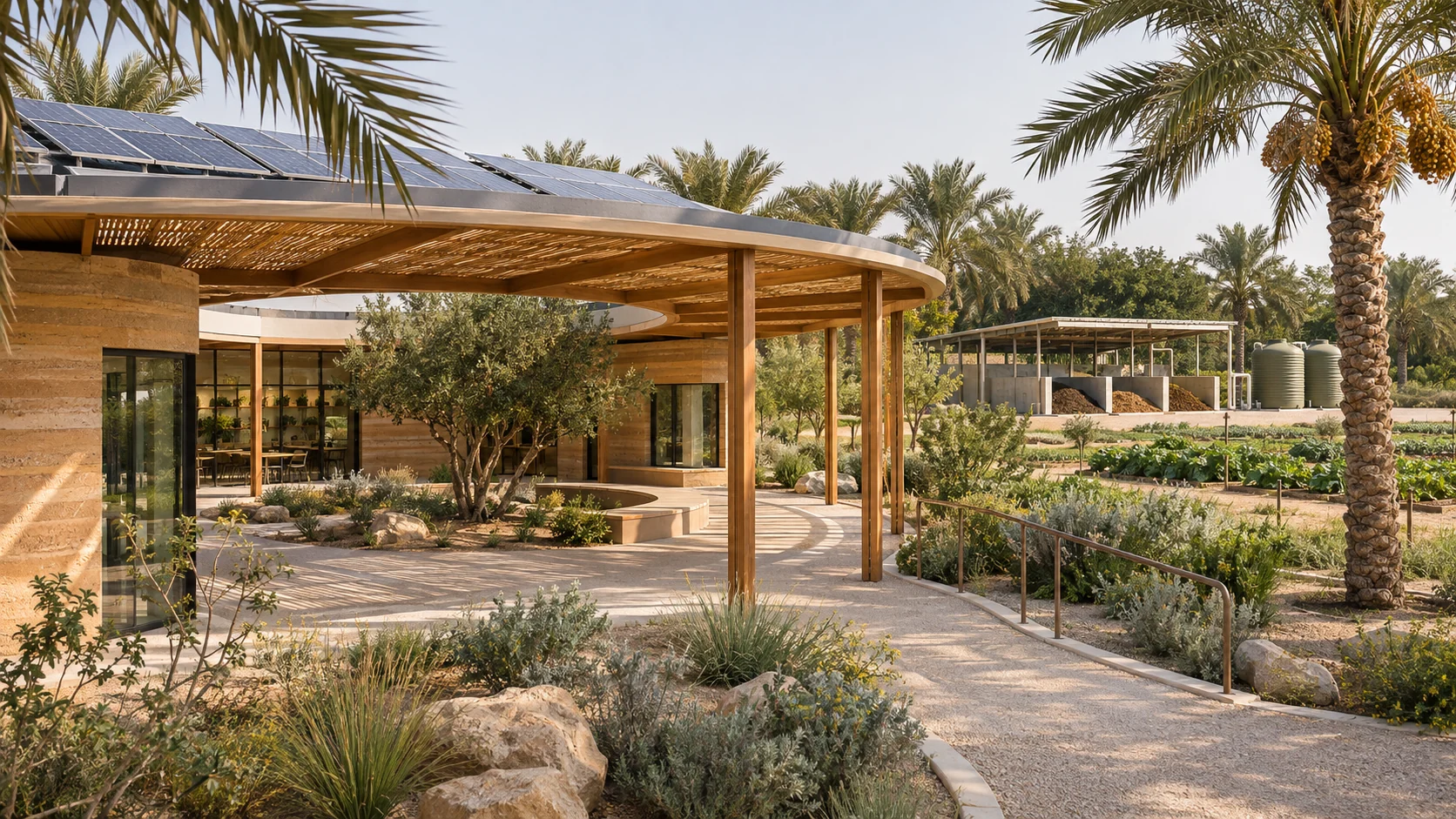
Concept of a shaded learning pavilion with solar roofs, adapted planting and separate recovery facilities
Architectural concept illustrating sustainability strategies; actual design and certification require assessment and review.
01

Organic materials return to soil

Sort suitable residues, convert them into monitored compost and check quality before application. Agricultural outputs become useful inputs when they meet application requirements.

02

Water managed by quality & purpose

Reduce losses through precision irrigation and leak detection, treating suitable streams for permitted reuse. Treatment is assessed for energy demand, salinity and water quality.

03

Energy produced & used efficiently

Combine solar, storage and load management with insulation, shading and suitable ventilation. Systems are sized to demand and maintained to extend their service life.

04

Knowledge improves operations

Farm data informs trials, case studies and training, with learning fed back into operations. Production, services and knowledge reinforce one another without assuming all waste or emissions disappear.

01

Agriculture and honey

Develop production suited to Abu Dhabi’s environment, connecting crops and bee forage with honey processing guided by Industry 5.0 principles. Human expertise, robotics and intelligent systems work together to pursue the highest quality, safety and sustainability standards and operational resilience, with clear traceability.

  • Cover crops and intercropping based on soil and water assessments.
  • A proposed apiary and honey extraction, processing and packaging facility using Industry 5.0 technologies.
  • Separate flows for raw materials and finished products, with traceability and food safety records.
02

Resources and energy

A recycling station designed to deliver green circular-economy objectives connects suitable farm residues with productive inputs through resource recovery and composting, with systems assessed for waste reduction and operating efficiency.

  • Aerated composting with process monitoring.
  • Assessment of water treatment and suitable reuse pathways.
  • Solar energy and photovoltaic canopies sized according to demand.
03

Practical learning and training

A proposed centre connecting learning with on-site experimentation and measurement. Programmes will be shaped by licensing, partnerships and demand.

  • Regenerative agriculture, soil health and water management.
  • Green buildings, energy efficiency and indoor environments.
  • Circular economy, composting and biological processing.
  • Carbon accounting, monitoring, reporting and verification.
  • AI, Internet of Things and environmental data analysis.
  • Honey quality, food safety and traceability.
04

Digital systems and facilities

A proposed operating environment combining a control room, support facilities and sustainable design within a plan subject to review and approval.

  • A control room connecting field readings and operational records.
  • Equipment and agricultural input storage designed for appropriate storage conditions.
  • Worker facilities designed with comfort, safety and indoor quality in mind.
Technology and delivery architecture

Four pillars. One connected operating model.

Production, recovery and learning share a common data architecture. This concept explains each facility’s role and how technology supports quality and resource efficiency before detailed design, procurement and commissioning.

01

Regenerative farming connected to an AI Hub

The plan progressively introduces no-till practices where appropriate to the soil and crop, maintaining cover and improving organic matter. An Internet of Things (IoT) network connects moisture, salinity and weather sensors and meters to a central AI Hub, informing precision irrigation and monitoring fields and facilities.

A Digital Twin represents fields and water and energy networks in a data-updated operating model, supporting scenario testing and fault detection. Readings are checked and models calibrated, with clear operating authority, safe stopping and human intervention when needed.

02

A robotic honey factory guided by Industry 5.0

The architectural concept uses a hexagonal, honeycomb-inspired factory integrating robotic extraction, sorting and filling with a quality laboratory and batch traceability. Zero-Touch handling is targeted at suitable production stages to reduce manual product contact, contamination opportunities and losses while improving consistency.

Design includes cleaning, maintenance, separated flows and control-point records to prepare for HACCP and ISO 22000 implementation. Qualified teams retain food-safety and operational responsibility, and each export market’s requirements are assessed before product release and shipment.

03

Intelligent recycling and treatment to close resource loops

A recycling station is designed to deliver green circular-economy objectives through aerated static pile (ASP) composting and treatment of suitable greywater for permitted reuse. Sensors manage temperature, moisture and aeration, linking input quantities and output quality to a common operating record.

Treatment conditions are managed to reduce methane, nitrous oxide and odours, while accounting for residual emissions and checking compost and water quality. The zero-waste ambition becomes sorting, recovery, reuse and measurement of rejected material, without assuming complete elimination of waste or emissions.

04

Environmental vocational training and Emirati capacity

A sustainable circular building is proposed as a vocational centre and living learning laboratory linked to field and facility operations. Programmes cover Green AI, carbon accounting, green buildings, systems control and robotics, with applied projects and assessment of acquired skills.

A proposed IHK-Hub cooperation pathway explores collaboration with German chambers. Programme and assessment recognition and use of the name require a written agreement with the competent body. Attendance certificates remain distinct from professional qualifications and authorised external credentials.
The farm as a living laboratory

Learning that moves into the field

The proposed centre connects teaching, operations and experimentation. Participants study a concept, observe the system, collect and analyse data, and produce a reviewable applied output.

Programmes are intended for farmers, asset managers, engineers, technicians and sustainability practitioners, according to each track’s entry requirements and level. In-person and hybrid sessions, specialist visits and team projects can be developed. Dates, capacities, instructors and certificate types will be announced once readiness, licensing and agreements are established.

Learning spaces & functions

01

AI & simulation laboratory

Workstations for farm-data analysis, energy simulation and dashboards.

02

Environmental measurement laboratory

Sample preparation and training with thermal, air quality, lighting and field-measurement instruments.

03

Lecture & hybrid-learning hall

Interactive teaching and discussion connected to farm observations and data.

04

Project & carbon workshops

Team spaces for inventories, trial plans, documentation and review.

05

Reference library & learning lounge

References, working guides and space for reading and knowledge exchange.

06

Administration & instructor offices

Programme coordination, content preparation, meetings and learning-quality management.

07

Reception & interactive exhibition

An introduction to the project, its performance indicators, materials and technologies.

08

Support & service spaces

Sanitation, prayer space, storage and technical and building services.

09

Environmental courtyard & circulation

A shaded planted courtyard and connecting routes, assessed for comfort and accessibility.

Capacity-building tracks

Six disciplines, shared applications

The concept includes foundation and specialist content connected to farm facilities. Outcomes, assessment and learning hours are programme-specific; any external awarding body is identified only when formally authorised.

01

Green buildings & environmental performance

Study of Estidama, Al Sa’fat and LEED concepts, building envelopes, lighting, ventilation and energy modelling. Participants connect assessment requirements with design decisions and operational evidence.

Applied output: a building assessment, evidence register and improvement plan. Preparation for LEED GA or AP exams is distinct from awarding the professional credential.

02

Circular systems & resource efficiency

Learning covers aerated composting, residue segregation, water balances, treatment and reuse. Resource recovery options are compared on quality, energy, cost and operating requirements.

Applied output: material and water flow maps, with a monitoring plan for product quality, emissions and operations.

03

Biological technologies & honey quality

Topics include biological inputs, storage and application, soil improvement trials, honey processing, food safety and traceability. Practical activities operate under safety procedures and specialist supervision.

Applied output: a batch operating sheet, traceability record and activity-appropriate quality testing plan.

04

Regenerative agriculture in dry environments

Planning cover crops, rotations, reduced tillage, salinity management, irrigation and pollinator protection. The focus is on testing and measuring practices rather than applying a single prescription to every site.

Applied output: a trial-plot plan with a baseline, operations schedule and soil, water and production indicators.

05

Carbon accounting, MRV & ESG

Define inventory boundaries and scopes, collect activity data and emission factors, and distinguish organisational inventories from emission-reduction projects. The track covers evidence records, carbon-project eligibility and environmental and social reporting.

Applied output: an inventory model, data quality plan and project outline exposing assumptions, uncertainty and independent verification needs.

06

AI & the Internet of Things

Read, clean and analyse sensor data with tools such as Python, connecting it to dashboards, digital twins and building energy systems. Model quality is checked before recommendations become operating decisions.

Applied output: a dashboard using training or authorised field data, documenting provenance, model limitations and alerts.

Watch & explore · Learning & capacity building

Carbon accounting and emissions auditing

A learning session on ISO 14064 and the GHG Protocol, supporting the carbon-footprint learning track and an understanding of accounting and review frameworks.

12:13Global Experts channelArabic audio
Explore the company channel
Watch on YouTubePlayer loads on click

Educational content from the company channel; not evidence of completed farm works or awarded certification.

How the systems work

From inputs to products, data and learning

01

Honey cycle: traceable quality

The cycle begins with colonies and forage, followed by batch collection, inspection and receipt in a defined area. Extraction, filtration, settling and packing lead to storage and dispatch under product-appropriate conditions. Batch identity, tests and operations support traceability and corrective action.

02

Resource cycle: value after treatment

Suitable organic residues are sorted, treated and checked before soil application. Water streams are separated and treated for permitted uses. Collection, energy, testing, maintenance and output quality are considered together so reuse is feasible and appropriate to the site.

03

Data cycle: from reading to decision

Sensor readings, work and production records, invoices and analyses enter an organised database. Units, outliers and calibration are checked before indicators and alerts are displayed. Decisions, actions and outcomes are logged, making data useful for improvement and review.

04

Learning cycle: application & assessment

Learners move from method explanation to field or facility observation, an analytical exercise, a short project and feedback. Documented trials can become case studies and professional workshops, protecting partner data and scheduling visits around safety and production.

Qualification before operations

The facilities and programmes shown are part of the development plan. Product availability, training and certification status will be established after the relevant procedures and agreements are completed.

Let’s grow a lasting impact.

We welcome interest from development, operations and knowledge partners.

Explore a partnership