Invest in an ecosystem
that produces. And regenerates.
Abu Dhabi Green Regenerative Farm is the proposed command hub for a 1,000-hectare grouped programme, combining intelligent agriculture, honey, learning and resource recovery in Abu Dhabi under one management, advisory and delivery partner.
- Funding sought
- 39.68%of total investment
- Proposed principal repayment
- 12months after opening
- Proposed repayment schedule
- 4quarterly installments
The term begins at the contractually defined final opening. Proposed repayments require cash-flow validation and agreed terms; capital and returns are not guaranteed.
A command hub for a scalable agricultural portfolio.
Abu Dhabi Green Regenerative Farm is being developed in Abu Dhabi as the Command Hub for a planned 1,000-hectare grouped agricultural portfolio. It combines regenerative agriculture and Industry 5.0 with an AI control hub, a Digital Twin, drones and robotics to coordinate work across participating farms. The central plan includes a robotic honey facility, a smart recycling station for composting and greywater treatment, environmental vocational training under the proposed IHK-Hub concept, and a carbon-asset development pathway subject to measurement and verification. Solar energy and green-building principles support Abu Dhabi’s knowledge economy, the National Food Security Strategy 2051 and the net-zero ambition for 2050. Facilities, credentials and partnerships remain within the development and qualification plan.
An Abu Dhabi command hub. A connected farm portfolio.
Equivalent to 10,000,000 m², or approximately 107,639,104 ft², across the central farm and participating farms. The concept connects fields to a shared management, data and service hub, documenting each farm’s boundaries, management rights and participation. This is the programme footprint, not the area of the central plot alone.
A plan to connect sensors, drones and robots, coordinating irrigation and field tasks with specialist oversight.
GROUPED PROJECT · dMRVA pathway to develop carbon assetsAssess farm eligibility, measure changes in soil organic carbon stocks and prepare evidence for registration, verification and potential issuance.
For investors and partners
We are developing an AgTech asset that connects production, services, data and training within scalable infrastructure. Value is built through operating efficiency, product quality, executable contracts and services for participating farms, with measured environmental, social and governance (ESG) indicators. An updated feasibility study must assess the investment and revenue implications of expansion; more hectares do not automatically increase valuation or returns.
Revenue sources and assumptions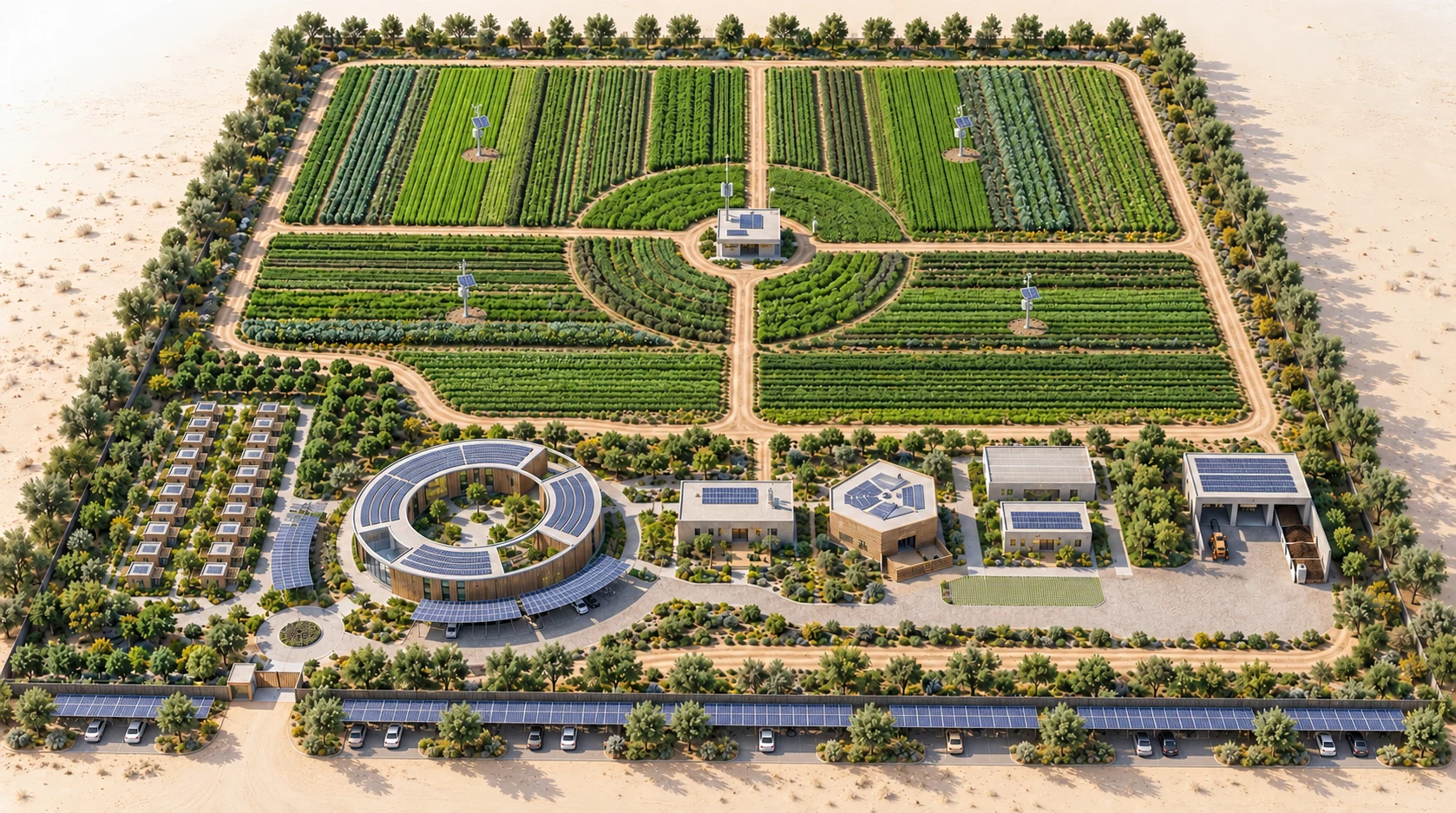
The investment, in numbers.
An integrated view of establishment costs, funding sources and the operating earnings implied by targeted revenue. Built from the attached financial model’s line items, with totals recalculated without double-counting.
The financial picture
Financing is separate from revenue. Operating earnings must convert into cash before they can fund repayments.
From 79.37% revenue to 50.79% operating earnings, relative to total investment
EBITDAWith target revenue as 100%, the model allocates 36% to operating costs and implies 64% in EBITDA. This margin reflects the supplied cost items and requires confirmation of cost completeness and sales delivery.
Establishment funding structure
% of total investment- External investor
- 39.68%of total investment Target contribution from an investor other than the owner
- Owner and partners
- 60.32%of total investment Balance needed to complete the funding requirement
The external funding request represents 39.68% of the total establishment and initial liquidity requirement of 100%. These percentages describe funding sources only, not equity or profit shares or paid-in commitments. The owner/partner balance is calculated under the owner’s stated funding structure.
Of total investment: arithmetic balance after principal repayment
50.79% EBITDA less 39.68% principal leaves an arithmetic balance of 11.11% of total investment. This is not free cash flow or distributable profit: taxes, collections, working-capital changes, subsequent investment and the agreed investor return still require monthly cash-flow modelling.
Where is capital allocated, and what does operation cost?
Original line items grouped by sector, with complete engineering and operating details available below.
Establishment and initial liquidity budget
25.2 millionThe training centre accounts for AED 5m, the honey factory AED 4.5m, and AI infrastructure AED 4m. Together they represent 53.6% of the budget, highlighting the production, learning and digital infrastructure in the model.
The total includes AED 23.2m in establishment, equipment and advisory items plus AED 2m working capital. The source groups these under CapEx; working capital is distinguished here for clarity, while final accounting classification requires review.
View all establishment line items and details15 items
| Item and sector | Amount | Source detail |
|---|---|---|
| Central control capsule and digital twin (AI Hub)AI infrastructure | 2,500,000 | Cloud servers and big-data software for managing 1,000 hectares |
| Drone fleets and advanced IoT sensorsAI infrastructure | 1,500,000 | Multispectral survey drones and deep moisture/carbon sensor network |
| Smart honeycomb building structureHoney factory (Industry 5.0) | 1,800,000 | Sustainable construction with high-performance insulation, targeting Estidama requirements |
| Robotic sorting and packaging linesHoney factory (Industry 5.0) | 2,700,000 | Robotic arms for honey and royal-jelly extraction and packaging |
| Sustainable building and fit-outVocational training centre | 3,500,000 | Circular centre, smart classrooms and building-integrated solar systems (BIPV) |
| Simulation and measurement laboratoriesVocational training centre | 1,500,000 | VR/AR laboratories for climate simulation and carbon-emissions auditing |
| Autonomous no-till agricultural machineryRegenerative agriculture and equipment | 1,800,000 | Smart electric tractors and GPS-guided precision seeding |
| Windbreaks and farm infrastructureRegenerative agriculture and equipment | 500,000 | Ghaf and Sidr planting and preparation of the reference site |
| ASP composting platform and greywater stationResource recovery | 1,200,000 | Enclosed systems designed to control methane leakage, with automated aeration sensors |
| Eco-lodge and worker accommodationSupporting facilities | 1,800,000 | Environmental guest accommodation and housing for specialists |
| Internal routes and electric vehiclesSupporting facilities | 600,000 | Internal logistics vehicles and charging stations |
| German partner consultancy (GIT GMBH)International advisory and qualifications | 1,500,000 | Knowledge transfer, Industry 5.0 automation design and training qualification work |
| Agricultural and environmental masterplan consultancyInternational advisory and qualifications | 800,000 | Regenerative-agriculture masterplanning and smart-irrigation design |
| Carbon and food qualification budgetInternational advisory and qualifications | 1,500,000 | Verra baseline/PDD preparation, external VVB fees and food-safety/HACCP work; FDA/EFSA are named in the source |
| Operating liquidity reserveWorking capital | 2,000,000 | Reserve allocated in the source to specialist salaries and marketing during the first nine months |
| Total without duplication | 25,200,000 |
Annual operating expenditure
7.2 millionTraining, administration and marketing total AED 2.45m; agriculture and facilities total AED 1.7m. Together they make up 57.6% of operating costs, making staffing, capacity, marketing and facility efficiency material to the margin.
View all operating line items and notes9 items
| Item and sector | Amount | Source detail |
|---|---|---|
| Cloud licences, digital twin and drone maintenanceAI and technology | 850,000 | Satellite-data SaaS subscriptions and precision-device maintenance |
| Factory operation, packaging and robot maintenanceRobotic honey factory | 1,100,000 | Robot maintenance, sustainable packaging and refrigerated export logistics |
| International specialists, trainers and administrationVocational training centre | 1,800,000 | Specialists delivering institutional training and consultancy programmes |
| International marketing and business developmentVocational training centre | 650,000 | Marketing to attract trainees from the GCC and Europe |
| Agricultural engineers and field workersAgriculture and facilities | 950,000 | Supervision of the main centre and associated land |
| Electric vehicles and agricultural equipment maintenanceAgriculture and facilities | 350,000 | Spare parts and routine maintenance |
| Microbial production inputs and water-station maintenanceAgriculture and facilities | 400,000 | Sustainable biological treatment materials |
| Licence renewals and continuing carbon verificationQualifications and advisory | 600,000 | Annual Verra-related verification and honey-quality testing budget as described in the source |
| Ongoing technology-partner supportQualifications and advisory | 500,000 | Technical support and maintenance contracts with technology partners |
| Total without duplication | 7,200,000 |
Liquidity reserve: the source earmarks AED 2m for salaries and marketing over the first nine months. It equals about 3.3 months of total operating costs at the arithmetic AED 600k monthly average; it does not fund nine months of all expenditure.
Eight streams. An AED 20 million target.
Every figure is tied to a volume, price or contract count. All values represent a full year at targeted operation.
Activities’ contributions to annual revenue
Carbon income excludedHoney contributes 33%, training 30%, and technical/advisory services 20%: three activities account for 83% of the target. Validating demand, contracts and delivery capacity for these streams is therefore a priority; multiple revenue streams alone do not establish customer diversification.
| Revenue source | Volume and price assumption | Annual · AED |
|---|---|---|
| Premium honey and packaged products | 20,000 kg × AED 330/kg | 6,600,000 |
| Professional and institutional training | 120 groups × 20 seats × AED 2,500 | 6,000,000 |
| Technical, advisory and data services | 40 contracts × AED 100,000 | 4,000,000 |
| Third-party honey processing and packaging | 100,000 service units × AED 10 | 1,000,000 |
| Crops and agricultural products | 30,000 kg × AED 20/kg | 600,000 |
| Compost and soil amendments | 900 tonnes sold × AED 1,000/tonne | 900,000 |
| Educational visits and practical days | 100 visits × 20 participants × AED 250 | 500,000 |
| Third-party waste-treatment services | 2,000 tonnes treated × AED 200/tonne | 400,000 |
| Total target revenue | 20,000,000 | |
Smart recycling station
AED 1.3m is included in the total: AED 900k from compost/soil amendments and AED 400k from third-party treatment. Product sales and service fees must be distinguished to prevent duplicate revenue and costs.
Carbon: a separate income opportunity
The source assigns no amount to carbon revenue. It remains outside AED 20m and every earnings/valuation calculation shown, pending eligible, issued and sold units and the project’s entitlement.
Reading the metrics and their limits
Metrics derived from the supplied line items, conditional on full operation and distinct from contractual investor returns.
12.8 ÷ 25.2 × 100
A simple annual operating ratio, not net ROI or the investor’s return.25.2 ÷ 12.8
Assumes steady full operation; excludes construction, ramp-up and cash timing.Illustrative EBITDA-multiple values
Source assumptionsThese are arithmetic values from applying the source’s 5× and 7× assumptions to AED 12.8m EBITDA. The source supplies no comparable transactions validating those multiples. They are not an approved market valuation or investor equity value; an equity assessment must address cash, debt, obligations and asset scope.
What is needed to interpret the figures correctly?
- Dashboard double-counting correction. Cells B3, B4 and B5 sum all of column C, including its total row. This page uses detail only: CapEx C2:C16, OpEx C2:C10 and Revenues C2:C9. The downloadable original is preserved as supplied.
- Distinguish earnings from cash. AED 12.8m is before interest, taxes, depreciation and amortisation. The file has no separate schedules for those items, collections, inventory or receivables, and does not establish cash availability at each repayment date.
- Cost completeness and project scope. Confirm honey/agricultural inputs, insurance, energy, land costs and contingencies, including what is already embedded. The 1,000-hectare scope in the model title is a target management footprint, not evidence of ownership or contracted land.
- Funding sources and repayment timing. Investor funding sought is AED 10m; the owner/partner balance is AED 15.2m. The 1.97-year simple whole-project payback differs from the proposed 12-month post-opening investor principal repayment, which needs a separate cash-flow schedule.
- Comparison with earlier project content. This section presents the attached V2 model totalling AED 25.2m. Earlier concept estimates retained elsewhere have their own scope and date and are not added to this budget. Named qualifications and partnerships in cost lines are planned requirements, not evidence of achievement.
Your contribution. A clear schedule.
The proposal seeks AED 10 million from one investor funding the full requirement or several investors making partial contributions. “Full participation” means covering the funding requirement; ownership, voting and distribution rights are agreed separately.
Principal repayment schedule
For partial funding, enter a share above 0% and below 100% of funding sought, with up to five decimal places. Examples do not establish a contractual minimum.
| Installment | Due after opening | Principal — % of contribution | Balance — % of contribution |
|---|---|---|---|
| 01 | End of month 3 | 25% | 75% |
| 02 | End of month 6 | 25% | 50% |
| 03 | End of month 9 | 25% | 25% |
| 04 | End of month 12 | 25% | 0% |
| Total scheduled principal | 100% of your contribution | ||
This schedule covers principal only. No return rate or profit share has been specified, and no assumed yield is added to installments. Management fees, payment priority, any security and exit rights are defined in the final agreement.
When does the term start and end?
The agreement defines final opening, operating-readiness criteria and handover. A pre-opening development programme must have an agreed duration before signing. Installments are proposed at months 3, 6, 9 and 12 after opening; delay consequences, investor priority and the process for closing participation and settling all entitlements are documented.
One asset. Multiple value streams.
A gross-revenue target subject to updated feasibility, demand, pricing and capacity validation. It is not net profit or cash entirely available for repayment.
How could annual revenue of AED 20 million be built?
The concept combines food production, learning, technical services, smart recycling-station revenues. Carbon-credit sales are presented as a separate additional opportunity outside the AED 20 million total. The model below shows the annual sales and delivery volumes that would mathematically reach the target, and the evidence needed before financial approval.
The AED 20 million target was provided by the project owner. The allocations, quantities and prices below for operating activities are illustrative modelling assumptions for discussion, not an approved feasibility forecast or verified market prices. No sales contracts or operating data substantiating these volumes were supplied in the reviewed documents.
Allocation update: to retain the AED 20 million arithmetic target without carbon, the honey assumption is AED 6.6 million: 20,000 kg × AED 330, with all other operating allocations unchanged. The proposed average price requires commercial validation; the adjustment does not establish additional sales.
- Annual operating revenue target
- 20,000,000AED · before costs
- Proposed operating streams
- 8Subject to validation and permissions
- Carbon-credit sales
- Additional revenueOutside AED 20m · assessed after measurement and eligibility
| Revenue source | Revenue assumption basis | Annual · AED | Share |
|---|---|---|---|
| Premium honey and packaged products | 20,000 kg × AED 330/kg | 6,600,000 | 33% |
| Vocational and corporate training | 120 cohorts × 20 seats × AED 2,500 | 6,000,000 | 30% |
| Technical, advisory and data services | 40 contracts × AED 100,000 | 4,000,000 | 20% |
| Third-party honey processing and packing | 100,000 serviced units × AED 10 | 1,000,000 | 5% |
| Crops and agricultural products | 30,000 kg × AED 20/kg | 600,000 | 3% |
| Smart recycling station: compost and soil amendments | 900 tonnes sold × AED 1,000/tonne | 900,000 | 4.5% |
| Educational visits and demonstration days | 100 visits × 20 participants × AED 250 | 500,000 | 2.5% |
| Smart recycling station: third-party treatment services | 2,000 tonnes treated × AED 200/tonne | 400,000 | 2% |
| Illustrative scenario total | 20,000,000 | 100% | |
Period: a full year at the assumed sales volumes after final opening. This does not establish that the first 12 months will reach that level; ramp-up, seasonality and collection require monthly modelling. The AED 1.67 million monthly average is an arithmetic division, not a cash-flow schedule.
In this scenario, training and technical services together account for 50% of the total, and honey for 33%. Demand evidence for these streams therefore has priority; multiple line items alone do not prove customer diversification or lower risk.
1,300,000 AED annually
AED 900,000 from compost and soil-amendment sales plus AED 400,000 from third-party treatment services. Together they represent 6.5% of the target and are fully included within AED 20 million, subject to capacity, permissions and contracts.
Station-service revenue details ↗Additional revenue beyond AED 20 million
The opportunity is assessed from eligible increases in soil organic carbon stocks across the farm and farms joining a qualifying grouped programme. Value depends on eligible agricultural area, measurement and baseline results, then registration, verification, issuance, sale and the project’s contractual share, without a predetermined amount.
How are carbon, added farms and income assessed? ↗Station accounting: treatment fees pay for a separate service, while compost sales concern a project-owned product. Both require contracts establishing these rights; input and output weights are distinguished and shared costs are not duplicated. On-site water treatment and reuse remain cost-saving benefits, not assumed water sales.
For each stream: customers, capacity, contracts and collection
01Premium honey and packaged productsAnnual assumption for assessment6.6 million
20 tonnes sold annually at an assumed average net selling price of AED 330 per kg within the revised revenue allocation.
- Target customers and channels
- Specialist food retailers, distributors, hotels, corporate gifts and e-commerce; exports only after destination requirements are met.
- Capacity and output validation
- Approximately 1.67 tonnes sold per month. Farm-apiary output must be separated from honey purchased from qualified suppliers; the full volume is not attributed to the site. Extraction, packing, storage and loss rates need validation.
- Evidence supporting the revenue
- Traceable supply contracts, quality records and purchase offers or distribution agreements defining volumes, net prices and returns. AED 330 is a modelling assumption requiring channel-specific validation.
- Proposed collection approach
- Direct collection for retail orders; agreed credit terms and limits for distributors and institutional clients, with returns and receivables tracked.
- Costs that must be deducted
- Purchased honey where needed, packaging, testing, filling, distribution, marketing and returns.
02Vocational and corporate trainingAnnual assumption for assessment6 million
2,400 paid programme enrolments per year; an enrolment is a seat in a programme, not necessarily a unique person.
- Target customers and channels
- Government bodies, companies, educational institutions, engineers and technicians across agriculture, AI, carbon and green-building programmes.
- Capacity and output validation
- The assumption requires 10 cohorts and 200 paid enrolments per month. Programme duration must fit rooms, instructor capacity and available days, with hybrid or client-site delivery assessed where needed.
- Evidence supporting the revenue
- Licensed programmes, tested pricing, instructor schedules and bookings or institutional purchase orders with binding minimum enrolments. A framework agreement alone does not establish participant numbers.
- Proposed collection approach
- Booking payments under a clear policy and collection tied to delivery and invoicing, distinguishing advances from services not yet delivered.
- Costs that must be deducted
- Instructors, materials, platforms, operations, marketing and any accreditation or training-partner fees.
03Technical, advisory and data servicesAnnual assumption for assessment4 million
An assumed average per annual service contract or technical project; deliverables, duration and value must be established separately for each contract.
- Target customers and channels
- Farms, food facilities and asset owners requiring environmental measurement, controls, resource-efficiency applications or operational technical training.
- Capacity and output validation
- This volume needs a delivery team, hours plan, tools and cost budget. Only contracts allocated to the project operating entity are counted; the advisory company’s unrelated revenues are not automatically included.
- Evidence supporting the revenue
- Service scopes, pricing and contracts with defined delivery and acceptance milestones, separating project rights, company and partner fees, and avoiding overlap with training revenue.
- Proposed collection approach
- Mobilisation and accepted-milestone payments with receivables ageing reports; percentages and terms are contract-specific.
- Costs that must be deducted
- Experts, visits, laboratories, software, subcontractors and management fees.
04Third-party honey processing and packingAnnual assumption for assessment1 million
A proposed commercial route: a service fee distinct from project honey sales, subject to pack-size and service-scope definition.
- Target customers and channels
- Apiaries and food brands requiring processing, packing and batch traceability under service contracts.
- Capacity and output validation
- Approximately 8,333 units monthly. Service hours must be combined with project-product packing, cleaning and maintenance to avoid allocating the same line capacity twice.
- Evidence supporting the revenue
- Service contracts defining honey ownership, quality responsibility, packaging and volumes. Only the service fee is counted; customer-owned honey is not included as farm sales.
- Proposed collection approach
- Booking payment and settlement on batch acceptance and delivery, or agreed terms for recurring clients.
- Costs that must be deducted
- Packaging materials if included, labour, cleaning, testing, energy and line maintenance.
05Crops and agricultural productsAnnual assumption for assessment0.6 million
Assumed sales volume and blended price for a product mix, not demonstrated yield or a common price for every crop.
- Target customers and channels
- Local retailers, restaurants, seasonal produce-box subscribers and direct customers for permitted products.
- Capacity and output validation
- The 30-tonne volume must be checked against net cultivated area, varieties, crop cycles, water, losses and seasonality. Own production and any external supply must be distinguished with origin disclosed.
- Evidence supporting the revenue
- A defensible crop plan, trial results or suitable comparable data, and purchase contracts or actual subscriptions specifying quality, price and delivery.
- Proposed collection approach
- Collection at sale or on agreed short delivery cycles, with spoilage and returns monitored.
- Costs that must be deducted
- Farm inputs, irrigation, labour, harvesting, grading, cooling and transport.
06Smart recycling station: compost and soil amendmentsAnnual assumption for assessment0.9 million
Only permitted products sold outside the project are counted; internal use is an operating benefit, not sales.
- Target customers and channels
- Farms, nurseries, landscapers and agricultural-input distributors, subject to product specifications and permissions.
- Capacity and output validation
- The assumption requires 75 tonnes sold monthly, supported by a material balance, treatment, maturation and storage space, and logistics. Farm residues alone are not assumed sufficient; authorised external feedstock must be assessed.
- Evidence supporting the revenue
- Suitable feedstock agreements, quality and maturity tests, validated capacity, and sales contracts or purchase orders. Product sales are separated from the third-party treatment fees shown in their own line, with feedstock and output ownership established and duplicate billing prevented.
- Proposed collection approach
- Batch sales supported by weights, quality records and invoices, with agreed collection terms and protections for credit sales.
- Costs that must be deducted
- Collection and transport, sorting, treatment, analysis, packaging, storage and distribution.
07Educational visits and demonstration daysAnnual assumption for assessment0.5 million
2,000 paid participations in a separate visit programme; training enrolments counted elsewhere are excluded.
- Target customers and channels
- Professional delegations, educational institutions and companies seeking introductory and applied farm programmes.
- Capacity and output validation
- Approximately 8–9 group visits monthly, within visitor capacity, safe routes and a schedule protecting production. The model does not assume rental of the owner’s lodge or tourist accommodation.
- Evidence supporting the revenue
- Relevant activity permissions and bookings or visit agreements defining service, capacity, price, cancellation and responsibilities.
- Proposed collection approach
- Booking and payment under published terms, with settlement before delivery or under a clear institutional agreement.
- Costs that must be deducted
- Guides, reception, appropriate insurance, materials, cleaning and coordination.
08Smart recycling station: third-party treatment servicesAnnual assumption for assessment0.4 million
An assumed AED 400,000 annually for receiving, sorting and treating suitable third-party organic residues, subject to activity licensing and service contracts.
- Target customers and channels
- Farms, nurseries and establishments with acceptable organic residues, under contracts defining material types, origin and permitted volumes.
- Capacity and output validation
- Approximately 167 tonnes of input monthly, to be assessed against station space, treatment and maturation time, storage, energy and handling. A shared material balance must connect inputs to assumed compost sales without asserting validated conversion yields or capacity.
- Evidence supporting the revenue
- Permissions for third-party waste reception and treatment, service contracts, agreed fees and weighing, acceptance and tracking records. AED 200 per tonne is a commercial assumption, not a government tariff or approved price.
- Proposed collection approach
- Periodic invoices tied to accepted and treated weights under the contract, with clear terms for rejected material, transport and settlement. Internal farm residue movements do not generate service revenue.
- Costs that must be deducted
- Transport if included, sorting, operation, energy, labour, testing, rejects and permissions. Shared costs with compost production are allocated once in the profitability model.
Agricultural carbon: from soil measurement to saleable value
Abu Dhabi Green Regenerative Farm aims to develop an agricultural carbon programme starting with its eligible land and expanding through additional qualifying farms. Income potential rests on measured and verified improvements in soil organic carbon stocks, followed by credit issuance and sale. This pathway sits outside the AED 20 million operating target, without a predetermined amount or financial percentage.
Eligible agricultural area
Map fields and management units in hectares, excluding buildings, roads and ineligible areas and preventing overlapping parcels. The accounting area is the eligible monitored land, not each property’s entire area.
From concentration to comparable stocks
Measure soil organic carbon (SOC) concentration through suitable sampling and analysis. Combine it with bulk density, depth and coarse fragments to calculate stocks per hectare. Compare measurements consistently over time, using equivalent soil mass adjustments where required.
Additional gains against the baseline
Assess stock changes from improved practices against the baseline over the monitoring period; existing soil carbon does not automatically become credits. Apply methodology requirements for emissions, leakage, uncertainty and non-permanence buffers before determining issuable quantities.
Registration, verification and issuance
Assess methodology eligibility, prepare the project description and monitoring plan, then complete independent validation and registration. Monitoring, independent verification and review precede issuance requests. Registration alone establishes neither issued volume nor sales revenue.
SOC percentage alone cannot estimate income: it describes concentration in a sample, while credits depend on documented additional outcomes over eligible land and a defined period. Sensors, drones and AI support data management and monitoring; they do not automatically replace soil-sampling or independent-verification requirements.
A hub for qualifying farms and their monitoring data
A Verra grouped project can be designed with predetermined geographic boundaries and eligibility criteria, with new farms assessed on inclusion. This supports gradual expansion of monitored land and assessment of shared measurement and verification costs at greater scale.
- Maintain a farm-level file: boundaries, management and practice history, baseline data, sampling plan, eligibility and inclusion dates. Do not apply one sequestration rate to all farms.
- Participation agreements define carbon and data rights, farmer obligations, duration, monitoring costs, benefit shares, and withdrawal or reversal provisions.
- Aggregate eligible areas and credits without duplication, checking for overlapping registration or sale through another project. Attribute only the project’s entitled share, rather than all participating farms’ sales.
How is the project’s sales income estimated?
Project income = sum of (issued and sold credits × contracted sale price × the project’s entitled share)
Estimate each issuance period and sale contract, then deduct project-borne development, sampling, laboratory, monitoring, audit, registration, issuance and brokerage costs to derive net returns. Account for partner shares only once and distinguish technical-service fees from credit-sale proceeds to avoid duplicate revenue.
Target institutional buyers or intermediaries through contracts defining units, monitoring period, ownership, delivery, price and collection. Neither a fixed unit price nor regular annual issuance is assumed, and investor installments are not tied to an unestablished issuance date.
Evidence needed before approving a carbon forecast
- Land and participating farms
- Eligible-area maps, farm register, participation agreements and carbon rights.
- Measurement and methodology
- Baseline and monitoring results, sampling and analysis plans, additional practices, and an applicable current methodology such as VM0042 after eligibility assessment.
- Issuance and sale
- Project registration, verification reports, available issued units and serial numbers, sale rights, buyer contract and collection terms.
- Project share and net returns
- Contractual benefit shares, costs, fees and risks, with a cash forecast separate from core operating revenue.
Current development stage: The reviewed documents did not provide approved carbon-stock results, a contracted participating-farm list, or evidence of registration, issuance and sale. The page therefore presents a development and expansion pathway without asserting confirmed carbon volumes or income. Any recycling-station emissions-reduction route requires its own eligibility and methodology assessment; it is not automatically added to soil credits.
Items excluded from scenario revenue
- Carbon-credit sales are entirely excluded from the AED 20 million total and the liquidity test below. Existing soil stocks and unissued, retired or previously sold credits are not counted as available units.
- Water and energy savings and internally used compost: may reduce costs when demonstrated, but are not additional sales.
- Knowledge licensing and operating franchises: future opportunities, without revenue assumed before rights and separate contracts are established.
- The AED 10 million investment is financing, not operating revenue. Land value and internal facility transfers are also excluded from sales.
What happens if sales volume or price changes?
An arithmetic simulation applying the same sales-realisation and price factors to the eight operating streams only. Additional carbon income remains outside every result in this test. It is not a market forecast or profit estimate and does not model differing margins or seasonality.
- Resulting annual revenue
- 20,000,000AED before costs
- Revenue share needed as cash for principal
- 50%To provide AED 10 million after obligations
At AED 20 million revenue, 50% must become cash available for repayment after operating costs, taxes, working capital and prior obligations, before any additional investor return. At AED 13.5 million, the requirement rises to about 74.1%. These are required proportions, not projected profit margins, and do not establish AED 2.5 million availability on each installment date.
What makes revenue more achievable?
The case becomes stronger when each figure is tied to evidence, capacity, responsibility and monitoring. The following are proposed operating and contracting measures, not existing guarantees or substitutes for buyer and execution risk assessment.
Evidence of commercial demand
Purchase and supply contracts or paid bookings should specify volume, price, delivery period, cancellation and payment obligations. Expressions of interest and framework agreements are distinguished from binding orders and are not counted as guaranteed revenue.
Available delivery and supply capacity
A common capacity plan must cover fields, honey and compost lines, rooms and technical teams, supported by input contracts, maintenance and permissions. The same capacity cannot be sold twice, and unverified output or permissions cannot support confirmed sales.
Controlled collections and liquidity
Use credit policies, suitable advance or milestone payments, documented invoices, receivables ageing and customer-concentration monitoring. Prepare monthly cash forecasts and a rolling 13-week update, with a liquidity reserve sized through financial analysis.
Clear rights and independent review
Document the contracting entity, revenue rights, management fees, project accounts and reporting. Any insurance, bank or contractual guarantee is presented as existing protection only after issuance and review of scope and conditions, without assuming it covers weak demand or every project risk.
Financial and commercial evidence status
Basis: activities in the supplied farm development document and project executive summary, and the owner’s target. The proposed scenario is not attributed to an approved study. Reviewed: 9 November 2026. Method reference: sales and cash-flow forecasting ↗ · Verra: registration, verification and issuance ↗ · EAD: waste management ↗
Value-added agriculture & food
Regenerative fields and an apiary connect to a honey facility developed around Industry 5.0 principles, integrating automation and robotics with human expertise and targeting the highest quality, safety and sustainability standards in processing, packaging and traceability.
Knowledge services alongside production
A vocational and environmental learning centre connects agriculture, green buildings, AI and carbon accounting to practical learning, subject to required permissions and partnerships.
Resource recovery & measurable costs
A recycling station is designed to deliver green circular-economy objectives by converting suitable organic residues into compost and recovering resources. It connects with suitable water recovery, solar power and precision irrigation to reduce waste and improve operating efficiency, evaluated in design and financial modelling.
An intelligent, scalable operating model
AI, sensors, drones and robotics are planned to coordinate fields and facilities, with documented processes and data supporting replication after operational performance is demonstrated.
Carbon: an additional opportunity with scope to grow
The AED 20 million annual operating target remains independent of carbon-credit sales. The carbon pathway is developed around soil organic carbon stock changes and eligible land at the farm and farms joining under clear agreements. Registration eligibility is assessed under an applicable methodology such as Verra VM0042; project income then follows issued and sold credits and its contractual share. This additional income is excluded from the financing repayment base.
Measurement, farm grouping and carbon incomeInvestment catalysts and strategic alignment
The opportunity connects food security, technology, knowledge and sustainability with Abu Dhabi’s knowledge-economy direction and UAE climate ambitions. These advantages become investment value when supported by feasibility, contracts and operating performance.
Local food and technology capability
The project combines premium honey and agricultural products with intelligent processing guided by Industry 5.0. Efficient irrigation and reuse aim to reduce groundwater pressure, with the water balance and supply sources established in design.
An assessable Agri-Tech asset
Control systems, data and operating procedures complement land and facilities. OpEx savings, quality and reliability are tested against technology and maintenance costs, providing an evidence-based valuation case rather than an assumed uplift.
Emirati talent and green jobs
The training centre can prepare Emirati talent in Green AI, robotics control, carbon accounting and green buildings. Skills connect to real tasks and assessable learning outcomes, with employment opportunities and partnerships defined in the operating plan.
Replication and knowledge licensing
Designs, software, procedures and training are documented in a repeatable blueprint. Once performance is demonstrated, replication across the UAE, technology licensing or regional operating franchises can be assessed, with intellectual-property rights and site adaptation defined.
Governance that supports due diligence
Documented ESG practices, risk registers and measurement support engagement with institutional investors and relevant funds. Suitability depends on each investor’s mandate, due diligence and feasibility findings, without guaranteed acceptance or automatic valuation multiples.
Revenue diversity and cash-flow discipline
The model includes honey and agricultural products, training and technical services, and compost or soil amendments permitted for sale, with a conditional carbon-credit pathway. Revenue is separated from profit and cash flow, and repayment capacity is tested after costs and working capital across demand scenarios.
How will funding support delivery?
This funding round seeks AED 10 million. Allocation connects construction, equipment, commissioning and start-up liquidity through a detailed budget reviewed with the investor.
Design, establishment & infrastructure
Studies, design, site preparation, green buildings and utility networks.
Agriculture & honey systems
Agricultural preparation, the apiary, and honey-processing, packaging and quality systems guided by Industry 5.0 principles.
Intelligent control, recovery & energy
Sensors, digital systems, robotic equipment, the recycling station and water, compost and energy facilities.
Learning & commissioning
Learning-centre fit-out, operating-team training, testing and handover.
Working capital & contingency
Start-up needs, operating liquidity and contingencies established in the feasibility study.
No unapproved allocation percentages are presented. The earlier AED 8.5 million establishment estimate on the project page remains a preliminary reference; AED 10 million is the current funding request, with differences reconciled in the updated budget before contracting.
Accountable delivery. Clear decisions.
Global Experts leads management, advisory and integrated delivery, coordinating partners, suppliers and technical teams through an agreed programme, deliverables and responsibilities. Its scope, fees and performance indicators are documented in the management and delivery agreement.
- 01
Assessment & agreement
Review land rights and feasibility; define funding structure, return, term and closing conditions.
- 02
Design & permissions
Confirm the design, facility scope and requirements, then approve budget and delivery schedule.
- 03
Procurement & delivery
Link disbursements to documented milestones and review procurement, costs and changes.
- 04
Commissioning & opening
Complete acceptance testing and team readiness, documenting the opening date that starts the repayment schedule.
- 05
Reporting, repayment & exit
Report operations and liquidity, track the four installments, then settle entitlements and close participation under the agreement.
Validate repayment capacity before commitment
Repaying AED 10 million in one year equals 50% of the AED 20 million annual revenue target, before operating costs, taxes, working capital and investor returns. Approval of the schedule therefore requires monthly cash-flow modelling, delayed-opening and lower-sales/higher-cost scenarios, and an identified source of liquidity for installments.
From interest to an informed decision
Discussions begin with a detailed presentation and a project-team meeting. Pre-contract review covers the following documents and questions, distinguishing available evidence from items still to be completed.
- Land and use rights, asset and ownership boundaries, and the contracting entity.
- Company trade licence, authorised signatory details, and the management/delivery agreement.
- Updated feasibility, the AED 10 million budget and key supplier quotations.
- Sales and cash-flow models, risk scenarios and repayment sources.
- Return or profit share, management fees, distribution priority, delay and exit mechanisms.
- Permission/certification status, delivery programme and final-opening criteria.
Is an investment return specified?
Not yet. It is negotiated according to the financing structure, risks and validated cash flows, separately from principal repayment.
What if opening or repayment is delayed?
Long-stop dates, remedies, rights and any agreed security are specified in the contract before funding. No undocumented protection or guarantee is assumed.
Is this a sale of land or established equity rights?
This page invites project-funding discussions. Participation structure, contracting entity, ownership or benefit rights and exit terms are determined after review and agreement.
Are certifications and carbon revenues already secured?
Qualification pathways are development objectives. Registration, credit issuance and certifications are not treated as achieved without supporting documentation.
Let’s discuss your participation.
Request the detailed proposal and a meeting to review feasibility, return and terms. The contribution below is your current calculator selection and can be changed before sending your request.
To request the project’s financial and investment file, please provide your official email address and contact details. Our team will send the file as soon as your request is received.
Proposal content reflects the project file, the owner’s instructions and the company’s published contact details. Figures and terms are indicative for discussion and create no financing commitment or guarantee; the final agreement follows the necessary technical, financial and legal review.