Sustainability & certification pathways

We begin with a clear baseline, then track soil, water, energy and results in the field.

Discuss the project
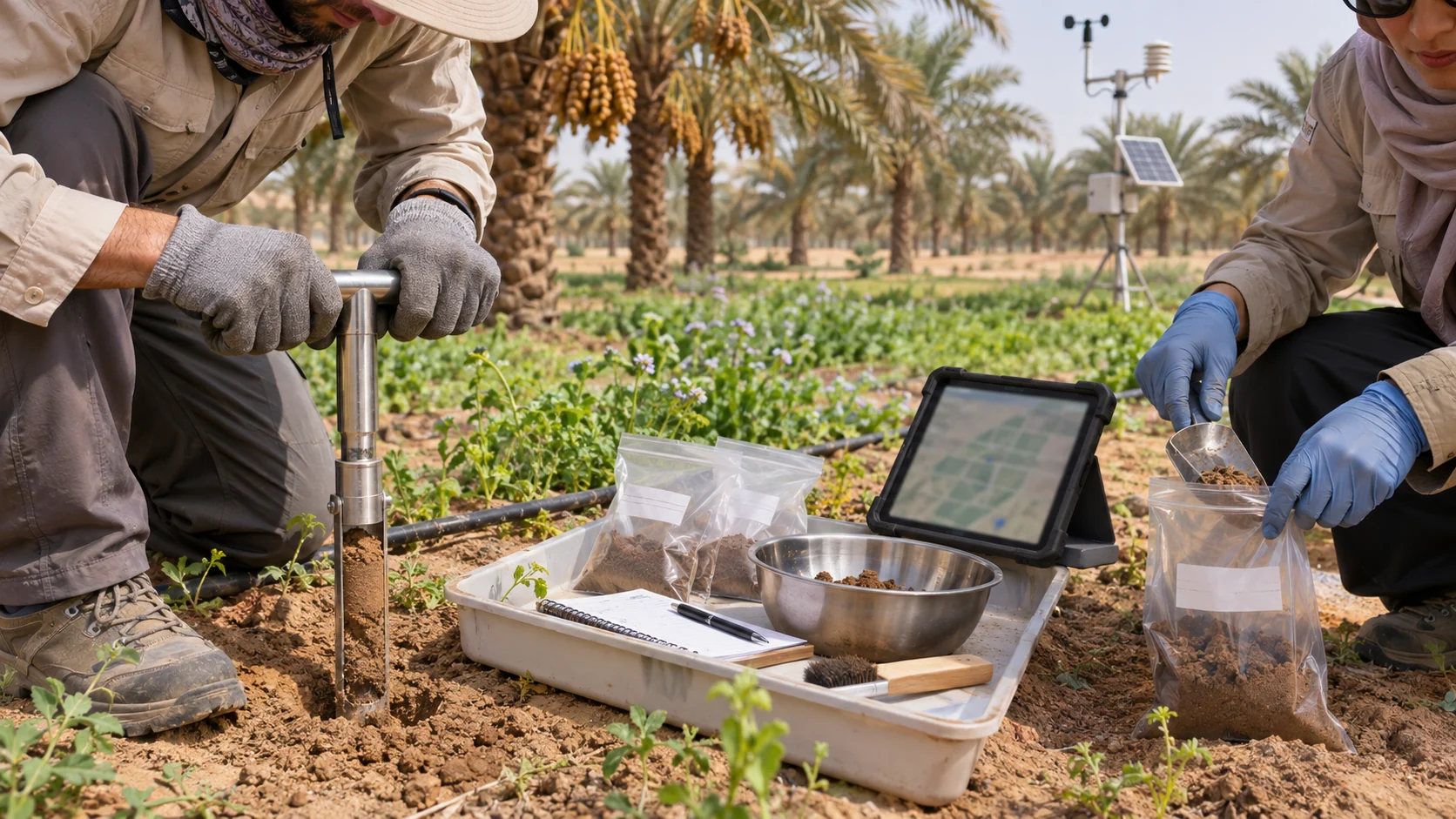
Illustration of soil sampling and documentation alongside farm monitoring equipment
Illustration of field measurement, not Verra verification or credit issuance.
VCS · VM0042 · MRV

Preparing the project for Verra registration

The Verra VCS pathway under VM0042 is being assessed for eligible farms within the planned 1,000-hectare grouped programme. Preparation defines geographic boundaries, participation criteria, carbon rights and baselines for eligible units, followed by monitoring changes in soil organic carbon stocks. Digital monitoring, reporting and verification (dMRV) combines practice records and sensing data with sampling, laboratory analysis and methodologically accepted modelling before independent assessment, registration and potential issuance.

The grouped footprint does not mean all land is eligible for carbon crediting or already registered. Farms must meet eligibility criteria, documented rights and safeguards against double counting. SOC percentage or existing stocks do not directly become credits: issuable quantities depend on baselines, additionality, uncertainty, deductions and independent assessment. Verra has not established final project eligibility.

Explore measurement and verification
Watch & explore · Data & emissions reduction

Carbon footprint: from data to action

Connect data collection, carbon accounting and emissions reduction planning to understand the foundations of the project’s environmental reporting and performance indicators.

5:59Global Experts channel
Explore the company channel
Watch on YouTubePlayer loads on click

Educational content from the company channel; not evidence of completed farm works or awarded certification.

Regeneration starts with evidence.

We aim to record practices, inputs and outcomes. This evidence informs operational improvements and supports independent review as the project matures.

01

WaterWater use and quality

Track irrigation use in relation to output and salinity.

02

SoilOrganic carbon and salinity

Repeat testing under a consistent sampling plan.

03

EnergyConsumption and energy sources

Review demand, reduction opportunities and renewable energy.

04

Production and knowledgeOutput quality and learning outcomes

Document traceability, operational results and learning outcomes.

From measurement to verification

The project targets readiness for Verra agricultural carbon registration, subject to eligibility assessment and supporting evidence. Improving soil alone does not create issued or saleable credits.

  1. 01

    Baseline

  2. 02

    Implementation

  3. 03

    Monitoring

  4. 04

    Verification and conditional issuance

Suitability and feasibility depend on the applicable methodology, field and laboratory measurement, registration and verification requirements. Digital data supports evidence and does not, by itself, replace verification.

VM0042 methodology — Verra
Environmental and national value

A clear ambition, demonstrated through data

Climate and circular-economy ambitions are translated into design, operations and reviewable indicators. Results are demonstrated progressively after implementation, distinguishing targets from measurements and verified outcomes.

01

Resource efficiency: a target tested against a baseline

The concept proposes an ambition to reduce water use and selected operating inputs by more than 40% in suitable applications through precision irrigation, monitoring and reuse. This is a planning target to be assessed, not a universal saving across resources or a measured result.

Each resource, crop and season needs a baseline and comparison per unit of output, including equipment energy and maintenance. This connects environmental improvements to the feasibility of operating-expenditure (OpEx) reductions.

02

Solar energy and lower-emission electric logistics

The concept assesses building-integrated photovoltaics (BIPV), solar generation, storage, load management and the feasibility of off-grid operation. Planned internal logistics prioritise electric and automated vehicles, with perimeter deliveries to limit conventional truck access.

Off-grid operation does not establish carbon neutrality. An inventory covers direct sources, purchased energy and the value chain within defined boundaries, with residual emissions assessed before a climate-performance claim.

03

Organic carbon: from digital monitoring to verification

Practices aim to improve soil organic carbon storage, with eligibility assessed under the applicable Verra VM0042 methodology and programme requirements. Digital monitoring, reporting and verification (dMRV) connects sensor data, inputs, practices, samples and analyses in an auditable record.

Digital tools support evidence quality without automatically replacing required measurement or independent review. Tradable units depend on completed procedures and registry issuance; an increase in soil carbon is not automatically an approved credit.

04

ESG governance and transparent impact

The environmental, social and governance framework tracks water, energy, emissions and recovery alongside safety, training, Emirati employment, worker rights and risk management. Each result has a measurement boundary, data source and accountable reviewer.

Periodic reporting presents progress, gaps and corrective actions to support investment due diligence. No 100% alignment or fund acceptance is claimed without a defined assessment framework, evidence and a decision by the relevant institution.
Agricultural carbon pathway reference: Verra VM0042 ↗

Qualification & compliance map

A pathway for each activity, evidence for each claim

These are intended pathways or options under suitability assessment, not certifications already awarded to the farm. Government permission, product certification, building ratings, individual credentials and carbon verification serve different purposes.

Compliance & Certifications

Compliance, certifications & licensing

Rigorous compliance with local legislation and international standards underpins Abu Dhabi Green Regenerative Farm’s operating continuity and its ability to pursue target revenues. The project therefore adopts an integrated licensing and qualification plan, connecting design, operations, food safety, training and environmental performance to reviewable evidence from development through operation.

LOCAL LICENSING

Buildings, agriculture & environment

The framework begins with land-use and economic licensing checks, building-permit requirements and the Estidama Pearl Rating System, coordinated with Abu Dhabi City Municipality and the competent authorities. It also covers applicable agricultural and operating licences for regenerative farming, apiaries and food facilities through the Abu Dhabi Agriculture and Food Safety Authority (ADAFSA).

Environmental assessment and licensing requirements are reviewed with Environment Agency – Abu Dhabi for the project and its smart recovery station. Water treatment and reuse requirements are coordinated with the relevant authorities, including the Department of Energy where applicable. The sustainability plan aligns with Ministry of Climate Change and Environment priorities and circular green-economy objectives.

FOOD SAFETY & MARKET ACCESS

Preparing honey for trade & export

The Industry 5.0 robotic honey facility targets HACCP principles and an ISO 22000 food-safety management system, covering hygienic design, hazard analysis, product testing, traceability and operating records. Readiness includes independent certification audit where sought and compliance with each destination market’s requirements.

For the US market, applicable Food and Drug Administration (FDA) requirements include facility registration where required, labelling and import procedures. For the EU, country and establishment eligibility, food safety, traceability and official certification requirements are assessed. The European Food Safety Authority (EFSA) provides scientific risk assessment; it does not issue export certificates.

SKILLS & SUSTAINABLE PERFORMANCE

Training, buildings & energy management

The training centre seeks cooperation with a specified German Chamber of Industry and Commerce (IHK), subject to a written agreement defining programmes, assessment, the certificate issuer and naming rights. Attendance certificates are distinguished from IHK certificates and professional qualifications; approval is only represented once documented.

The project also targets LEED v5 certification for suitable buildings under the applicable rating system and scope, alongside ISO 50001 energy management and performance improvement. Each pathway requires the relevant design and operating evidence and review; solar installations or automation do not automatically confer certification.

CARBON ACCOUNTING & VERIFICATION

From measurement to registration & issuance

Carbon accounting follows the applicable parts of ISO 14064 for greenhouse-gas inventories, project outcomes and verification. In parallel, the farm and additional participating farms are assessed for eligibility under Verra VCS and the current VM0042 methodology, with defined rights, baseline, additionality and a measurement and monitoring plan.

Project documentation and outcomes undergo independent validation and verification and registry procedures before any potential credit issuance. Registration, issuance and sale are distinct stages. Additional carbon revenue is based on credits actually issued and sold, outside the AED 20 million annual operating-revenue target.

Pathway status: targeted qualification. Approvals and certificates are presented as issued only after their scope and validity are documented and checked. Detailed pathways and official references follow below.

01
Land, activities & facilities

Local licensing & approvals

Target pathway

The pathway begins with land use, operating rights and proposed economic activities, followed by agriculture, food, building, environment, safety and water requirements for each facility. An approvals register identifies authorities, documents, responsibilities and dependencies.

Reference authorities include ADAFSA, DMT, EAD, Civil Defence and activity-licensing bodies; listing them does not imply approval.

Official reference
02
Practices, inputs & products

UAE organic production

Target pathway

A pathway assesses farm management, inputs, records, traceability and handling under the applicable organic system. Scope, certification body, conversion and inspection must be established; reduced fertiliser use or compost application alone does not make a product certified organic.

A certified claim requires a valid certificate covering the relevant product and activity.

Official reference
03
GLOBALG.A.P. IFA

Good agricultural practices

Target pathway

The project considers IFA for its plant-production scope, covering food safety, traceability, environment, worker health and production processes. Preparation includes written procedures, risk assessment, input and water records, internal checks and audit by a scheme-approved certification body.

This is a production-practice certification, not proof of organic status or issued carbon credits.

Official reference
04
ROC

Regenerative Organic Certified

Target pathway

This pathway combines soil health, animal welfare and social fairness. Eligibility starts with the programme’s accepted organic baseline, followed by a gap analysis of management, practices, implementation evidence and the appropriate farm scope.

The name represents an eligibility and preparation target; the supplied file contains no issued project ROC certificate.

Official reference
05
Savory EOV / Land to Market

Ecological Outcome Verification

Target pathway

EOV focuses on land outcomes in grassland and related integrated systems. It is considered if a suitable grazing component exists; pure cropping systems are generally outside the current scope except for the pilot projects identified by the programme.

Land-outcome verification is distinct from issuing a carbon credit or certifying every farm activity.

Official reference
06
Building performance in Abu Dhabi

Estidama Pearl Rating

Target pathway

The plan considers an advanced rating for suitable buildings through water, energy, materials, indoor environment and site integration. The applicable rating tool and scope are selected, with a scorecard and design and construction evidence.

Two or three pearls are discussed in the document. Any final rating depends on official review and is not presented as achieved.

Official reference
07
Centre & eligible buildings

LEED v5 green building certification

Target pathway

A suitable building may be registered under LEED v5 using the rating system matching its use, scope and eligibility, with energy, water, materials and indoor-environment evidence. Certification requires project review and is separate from preparing individuals for LEED professional examinations.

A particular floor area or solar installation does not automatically confer LEED certification.

Official reference
08
Honey processing & handling

Food safety: HACCP & ISO 22000

Target pathway

Readiness begins with hygienic design, sanitation, maintenance, pest control and traceability, followed by hazard analysis and monitored controls. Operating records connect to product tests, staff training, complaints and recall arrangements. ISO 22000 is considered for an integrated food-safety management system covering responsibilities, communication and continual improvement, with independent audit when certification is sought.

HACCP implementation does not replace facility licensing or product and destination-market requirements.

Official reference
09
European, US & other markets

Potential honey export readiness

Target pathway

The concept assesses destination requirements before equipment investment: safety, authenticity, residues, labelling and traceability. For the EU, country and establishment eligibility, listing, official certification and consignment conditions must be checked with competent authorities at export time. For the US, applicable FDA requirements are assessed, including facility registration where required, food safety, labelling and import procedures.

The document does not establish export approval. EFSA assesses scientific risk rather than granting a factory export permission, and FDA facility registration is not product approval. HACCP alone does not establish EU market access.

Official reference
10
GHG Protocol / ISO 14064

GHG accounting & verification

Target pathway

The programme distinguishes an organisational inventory under ISO 14064-1, project reductions or removals under ISO 14064-2, and validation and verification under ISO 14064-3. Boundaries, data sources, emission factors, uncertainty and evidence are set for each purpose.

Preparing or verifying an inventory does not automatically issue credits; a crediting programme has additional requirements.

Official reference
11
Verra VCS / VM0042

Agricultural carbon pathway

Target pathway

Land and practice eligibility are assessed under the current methodology, followed by baseline, additionality, monitoring, leakage and non-permanence risks. Project documentation and records support programme procedures and independent assessment before any potential issuance.

The site’s size calls for assessing measurement and verification costs and possible aggregation with other farms; a registry account is not credit issuance.

Official reference
12
Programmes, instructors & partners

Training qualification & professional cooperation

Target pathway

The concept explores professional cooperation with educational institutions and German chambers such as IHK and HWK, subject to defined programmes, assessments, agreements and naming rights. Course attendance is distinguished from a professional qualification or externally issued credential.

The centre is not represented as a branch, examination centre or approved provider without written authorisation covering that role.

Official reference
13
Facilities, energy & loads

ISO 50001 energy management

Target pathway

An energy-management system is considered to define policy, responsibilities, baselines and performance indicators for significant loads, including processing, treatment, irrigation and training. Metering and intelligent control connect to an improvement plan and periodic review of solar, storage and equipment performance.

ISO 50001 supports performance management and improvement; solar installation does not automatically confer certification, and no project certificate is claimed before issuance by a competent body.

Official reference

How is certification managed?

Define scope and scheme; analyse gaps; prepare procedures and evidence; review internally and close findings; submit and undergo independent audit where applicable; receive the competent body’s decision; monitor validity and renewal. A certificate register records document number, scope, issuer and issue/expiry dates.

The evidence chain

From a soil sample to a reviewable result

The proposed measurement system separates operational improvement, organisational inventories and carbon projects. Each has its own boundaries, evidence and calculations, while suitable data can be reused without confusing outcomes.

01

Boundaries, rights & management history

Document the plot, management units, land/data/carbon rights, and historical crops, inputs, irrigation and practices. Define who operates the project, owns evidence and reviews it, and check eligibility before estimating potential credits.

02

A repeatable sampling plan

Stratify representative soil units and specify sample locations, depths, timing, bulk density and chain of custody. Use suitable analytical methods to distinguish organic and inorganic carbon, with quality controls for spatial variability and uncertainty.

03

Inventory emission sources

Scope 1 covers direct sources within the defined boundary, such as fuel and relevant soil and process emissions. Scope 2 covers purchased energy; Scope 3 evaluates inputs, transport, services and the value chain according to significance and report boundaries.

04

Compare scenarios & risks

Compare project outcomes with an appropriate baseline, addressing additionality, displaced activities and risks of later carbon loss. Calculations consider associated water, energy, input and recovery-process emissions rather than gross carbon storage alone.

05

Independent review & issuance

Prepare project documentation and monitoring records for the selected programme, resolve findings and complete registration, verification and issuance decisions. Opening an account, operating a dashboard or writing an internal report does not create saleable units.

06

Scale & aggregation feasibility

The documented site is approximately 2.787 hectares, so sampling, development and verification costs must be compared with potential outcomes. Aggregation of eligible farms may be considered with clear rights, data and benefit-sharing arrangements, without assuming standalone credit profitability.

Data quality & transparency

Readable indicators, traceable records

The digital platform supports operations, learning and reporting. Each value carries its source, unit, period and review status, distinguishing readings, estimates and verified outcomes.

01

Digital record governance

Consistent identifiers for plots, devices, samples and batches, with access roles, timestamps, change logs and backups. Calibration records, analyses, invoices and action evidence are retained with assigned review and closure responsibilities.

02

Soil, water & production

Indicators track soil properties, salinity, organic matter, water use by zone and crop, output quality and inputs. Comparisons such as water per unit of production account for season, product type and changing planted areas.

03

Energy, recovery & biodiversity

Track electricity, fuel, solar output, materials received, treated and rejected, and compost quality. Monitoring also covers plant cover, pollinators and tree condition using consistent comparison protocols.

04

Social outcomes & ESG reporting

Track training outcomes, safety, worker welfare, grievances and partnerships alongside environment and governance. Periodic reporting can set out baselines, methods, outcomes, limitations and next actions, distinguishing self-reporting from independent assurance.

Understanding the project

Clearer knowledge, better decisions

Is the farm certified or fully operational?

The site presents a project in development as described in the supplied document. The source does not include issued certificates establishing farm certification or completion of every facility. Each status can be updated when supporting documents are available.

How do sustainability, regeneration and organic production differ?

Sustainability is a broad approach to impacts and resources. Regeneration here focuses on improving soil and ecosystem functions through measured outcomes. Certified organic status follows a defined system of inputs, practices, inspection and certification. These pathways can overlap without replacing one another.

Does increased soil carbon mean a saleable credit?

No. Attribution requires a baseline, methodology, eligibility and additionality, alongside emissions, uncertainty and risk assessment, followed by programme registration, assessment, verification and issuance. The same outcome must not support conflicting claims or transactions.

What is the difference between SOC and SIC?

SOC is soil organic carbon, while SIC is inorganic carbon, including carbonates. Calcareous soils require clear distinction, appropriate analysis and identification of the fraction eligible under the chosen methodology. Results should not be merged without explanation.

Are AI or satellite observations sufficient for verification?

They can interpret data, detect change and guide sampling, but do not alone replace field and laboratory evidence or methodology requirements. Estimates are separated from measurements, and models are checked for validity, accuracy and appropriate use.

Does training automatically grant an international credential?

No. The issuer, certificate type, scope and conditions must be identified. Attendance, an internal assessment, an external professional examination and building or project certification are distinct and should be stated in each programme description.

Content is based on the supplied farm management and development document, with repetitions consolidated, ambitions distinguished from outcomes, and pathway descriptions checked against official sources. Content reviewed: November 2026.

Let’s grow a lasting impact.

We welcome interest from development, operations and knowledge partners.

Explore a partnership